
Auxiliar de Conversación Budget: Exactly How Much I Make (And Spend) Each Month In Spain
If you ask most applicants to the auxiliar de conversación program what their biggest concern is when deciding to move to Spain to teach English, chances are, you’ll hear the same response…money.
After all, auxiliares de conversación only make between €700-€1,000 each month in exchange for 12-16 hours each week of work. While this is totally a fair amount for the hours you are working and cost of living in Spain, most auxiliares come prepared with savings from home, and nearly every auxiliar I know has some form of supplemental income (teaching private lessons, working in an academy, etc.).

If you have never lived in Spain before, it may be difficult to gauge just how far these Euros will go each month and what living expenses are like.
To give everyone some insight into expenses in Spain, I’ve spent the last few months tracking every, and I mean EVERY, purchase I have made, from €1 cafe con leches to €200 flights.
It is important to note that my auxiliar de conversación budget may not (and probably won’t) work for everyone! Some areas in Spain are more expensive, you may decide to travel more (or less) than me, or you may simply spend your money differently. The following monthly breakdowns are simply meant to demonstrate what my personal experince has been working, traveling, and spending in Spain as an auxiliar de conversación.
About My Auxiliar de Conversación Budget
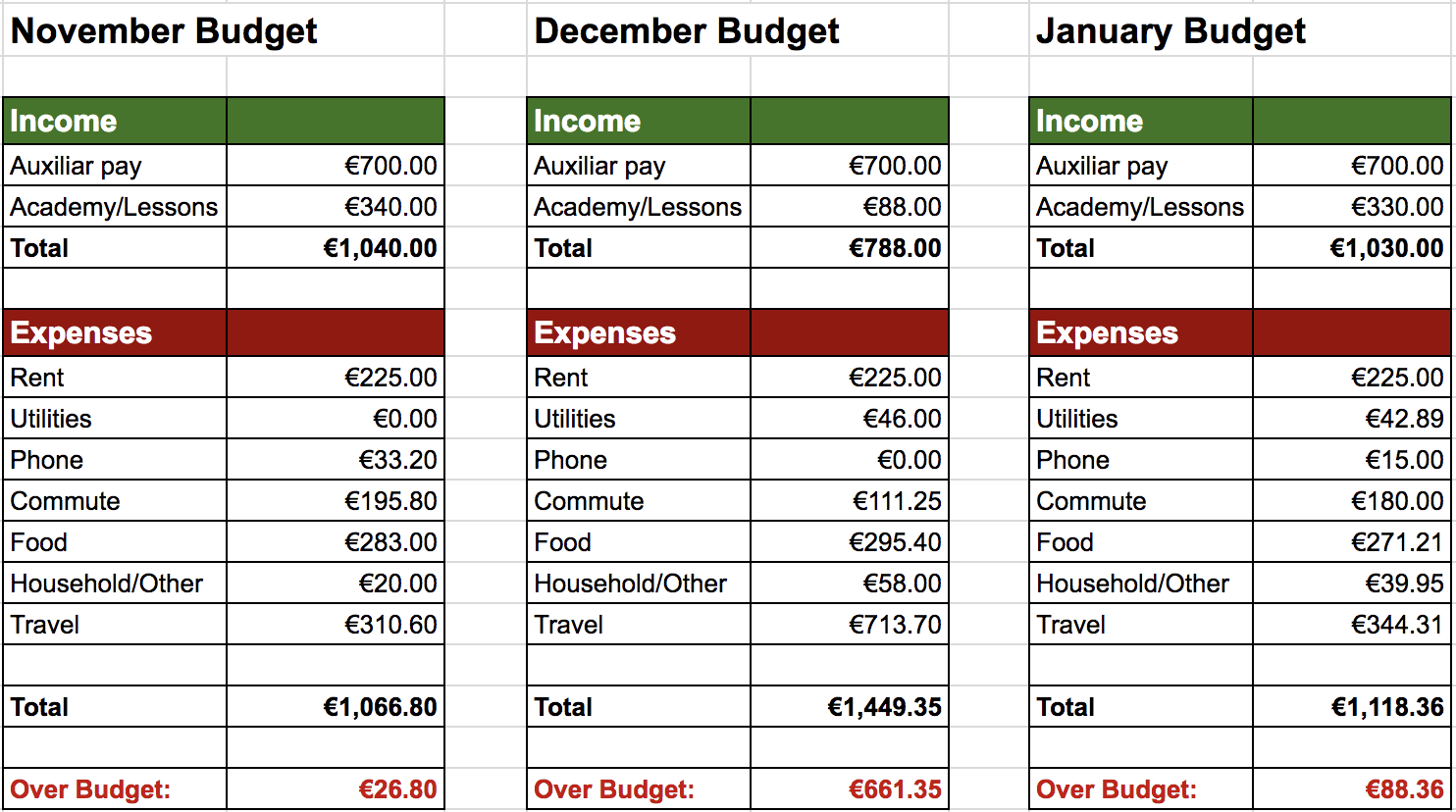
To help you see the areas in which your budget may differ from mine, I’d like to quickly highlight some areas that affect my earning and spending.
- I make €700 each month as an auxiliar de conversación in Andalucía.
- Andalucía is one of Spain’s less expensive regions.
- I live with 2 roommates, and our apartment is €225.00 per month, per person, plus utilities.
- Utilities are surprisingly expensive in Spain! We are billed for water trimonthly, and electricity bimonthly, which is why these areas will appear inconsistent on each monthly budget. (~€51.80 each month)
- I live in Sevilla, but take the train each day to school. My commute is quite expensive! (~€180.00 each month)
- I work 6 additional hours each week in a language academy and also teach 1 private lesson. (~€300.00 each month)
- I typically travel 1 time per month, generally for the weekend, and often outside of Spain.
- Occasionally I travel twice in one month or take a day trip.
- When in Sevilla, I typically cook my own meals, rarely eat out, and I don’t often shop for items such as clothing.
- When I travel, I travel on a budget, but I do eat out and I never skip an activity or experience due to money.

It should also be noted that I came to Spain with savings, and when I refer to myself as being “over” budget, I simply mean over my income for the month, as I try to dip into my savings as little as possible! Gotta save up for more adventures!
I highly recommend coming to Spain with funds saved up, especially if you plan on traveling at all. Depending on how much you plan to travel, where you live, your apartment costs, and how much you typically spend monthly, I would come to Spain with at least $3,000 saved. There are people who have come with less, but more never hurts, and I think it is important to have money saved up for incidentals! It is common for schools to be 2-3 months late with payments (fortunately, mine have always been on time)-so you’ll want to be able to support yourself until those funds come in.
Initial Costs
There are a few initial costs to be aware of when moving to Spain as an auxiliar de conversación. Here are some of the major ones you’ll want to prepare for, along with some rough cost estimates (which will vary greatly depending on your circumstances):
- Your visa and other documents necessary to move to Spain (~$200)
- Flight to Spain (~$700)
- ~1-2 weeks food and accommodation while you apartment search (~€300-€400)
- First months rent, deposit, and possibly a realtors fee. (My apartment is €225, the deposit was €225, and the fee was €225, so up front, I paid €675)
September/October
I moved to Spain on September 16th, and moved into my apartment by September 22! Luckily, I only had to spend 1 week paying to stay in an Airbnb. Unfortunately, I was quite busy settling in during September and October and totally failed at keeping up with my budget. (We also didn’t have internet which did not help the situation!) You can read more about my first month settling into Spain here.

While I don’t have the exact figures for my expenses during my first 1.5 months in Spain, I do know that I spent more than a typical month in Spain. After all, in your first month, there are a lot of odds and ends to take care of. I dined out more as I was meeting new friends and getting to know the area, purchased household items like sheets and cleaning supplies, and did some shopping I had postponed until moving. It also took me a couple of weeks to start my second job, so I made less this month. Additionally, I had no income during September, as the school year begins for auxiliares in October. During this time, I spent weekends in Portugal and Cadiz, and took a 1/2 day trip to Italica.
November
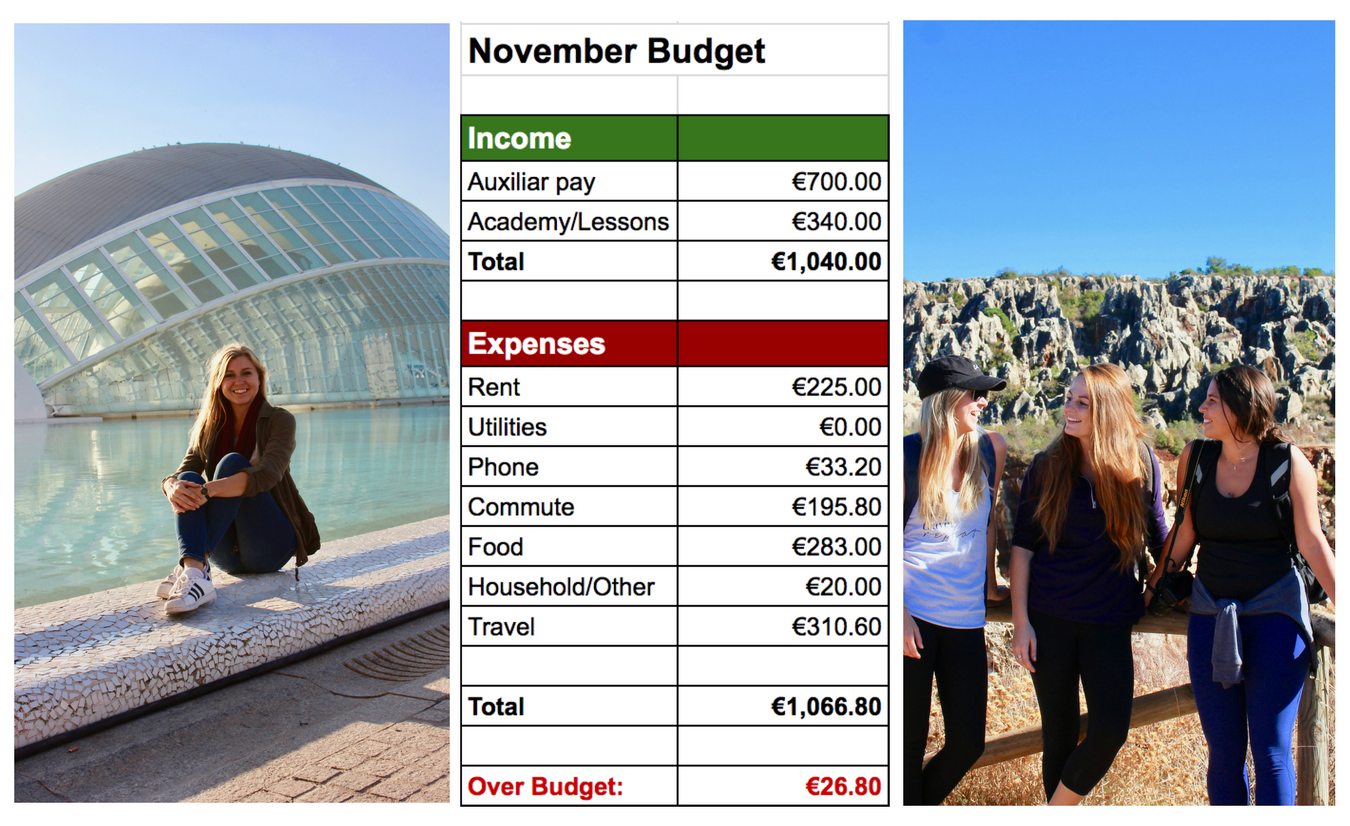
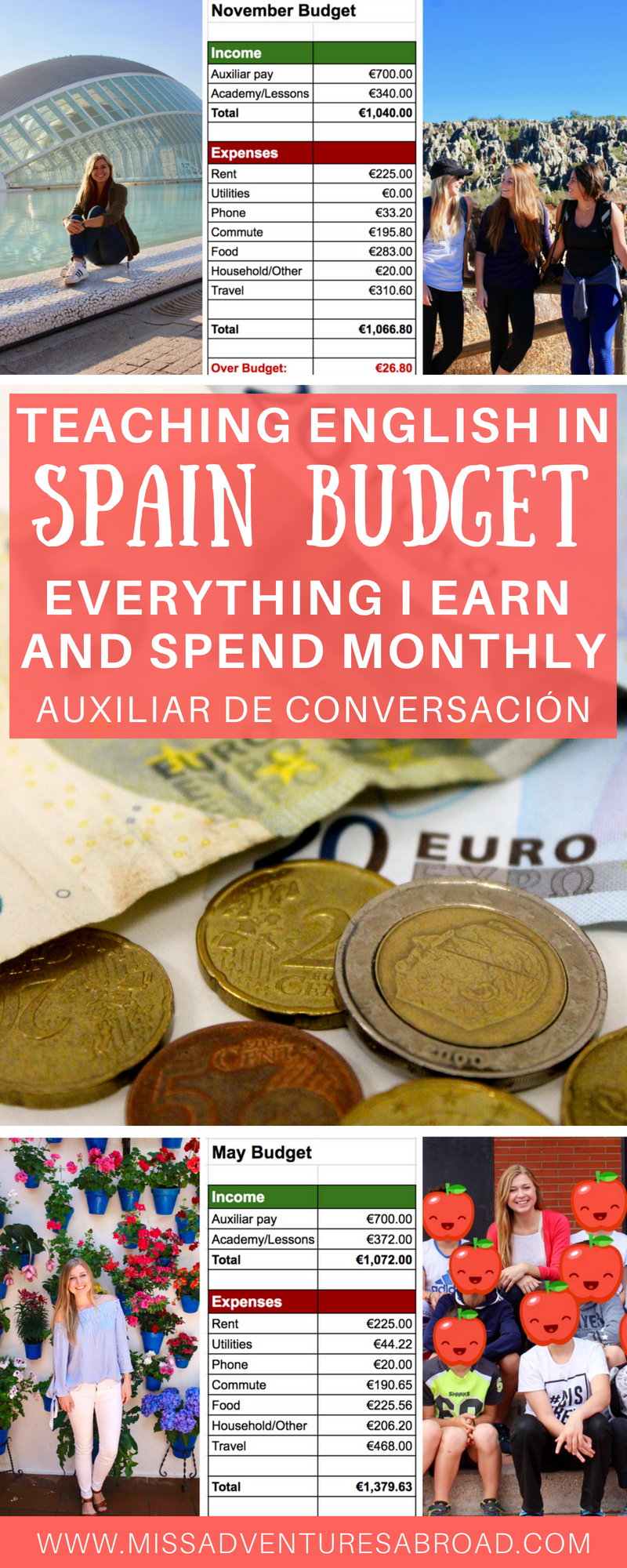
I’m happy to report that by November, I finally was able to start reliably tracking my expenses! I had little trouble sticking to my budget in November and wound up only spending €26.80 more than I earned. I kept my travels during this month limited to Spain, heading on a hike with friends just outside of Sevilla and to Valencia for the weekend via 1/2 priced overnight bus tickets. (Thanks for the sale, ALSA!) Check out my November auxiliar update for more on Thanksgiving, Black Friday, and teaching!
December
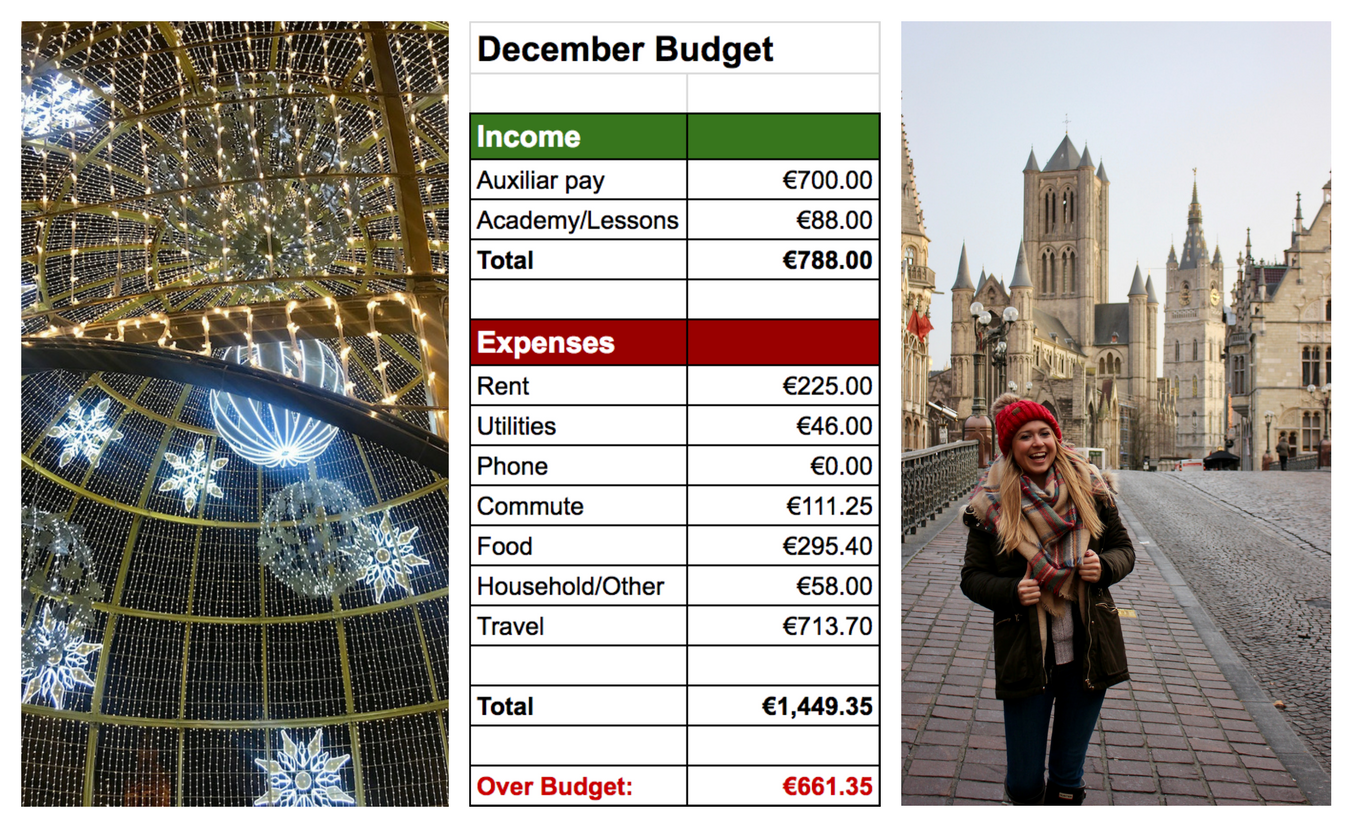
Not surprisingly, December was one of my most expensive months in Spain. I blame the holidays! We had a long weekend which I took advantage of by booking a ridiculously expensive flight to Belgium so I could visit someplace that felt festive during the holiday season. Additionally, I traveled home from Spain for Christmas (although I will admit that my parents very generously paid for my flight, thanks mom and dad!). Another reason this month was more expensive than usual was the fact that the long weekend and time off for Christmas meant that I only made €88.00 by working at my second job, over €250.00 less than the previous month. Read more about my experiences teaching in Spain in December here!
January
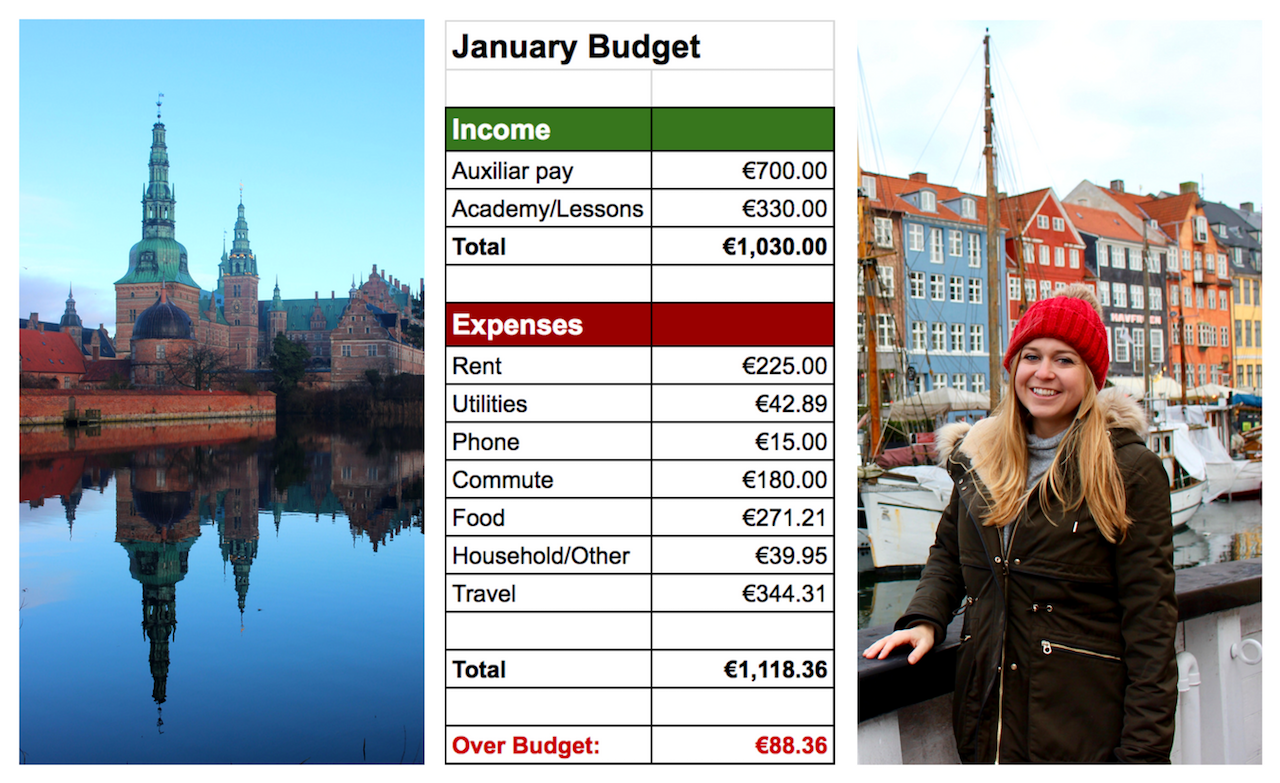
Miraculously, I managed to come out of January just €88.36 over budget. While €88.36 is quite a bit over budget when you consider that it’s over 10% of my monthly income, I spent a long weekend in Copenhagen, which is known for being a more expensive city! It did help that I was on a solo trip, and I took care not to spend much on food, opting instead to spend more on museums. I also took a day trip with a friend to nearby Merida, but the bus fare was pretty cheap so it didn’t wrack up my expenses much. I also was home the first few days of January, so I had minimal living expenses during those days. You can learn more about how I spent this month in my January auxiliar update.
February
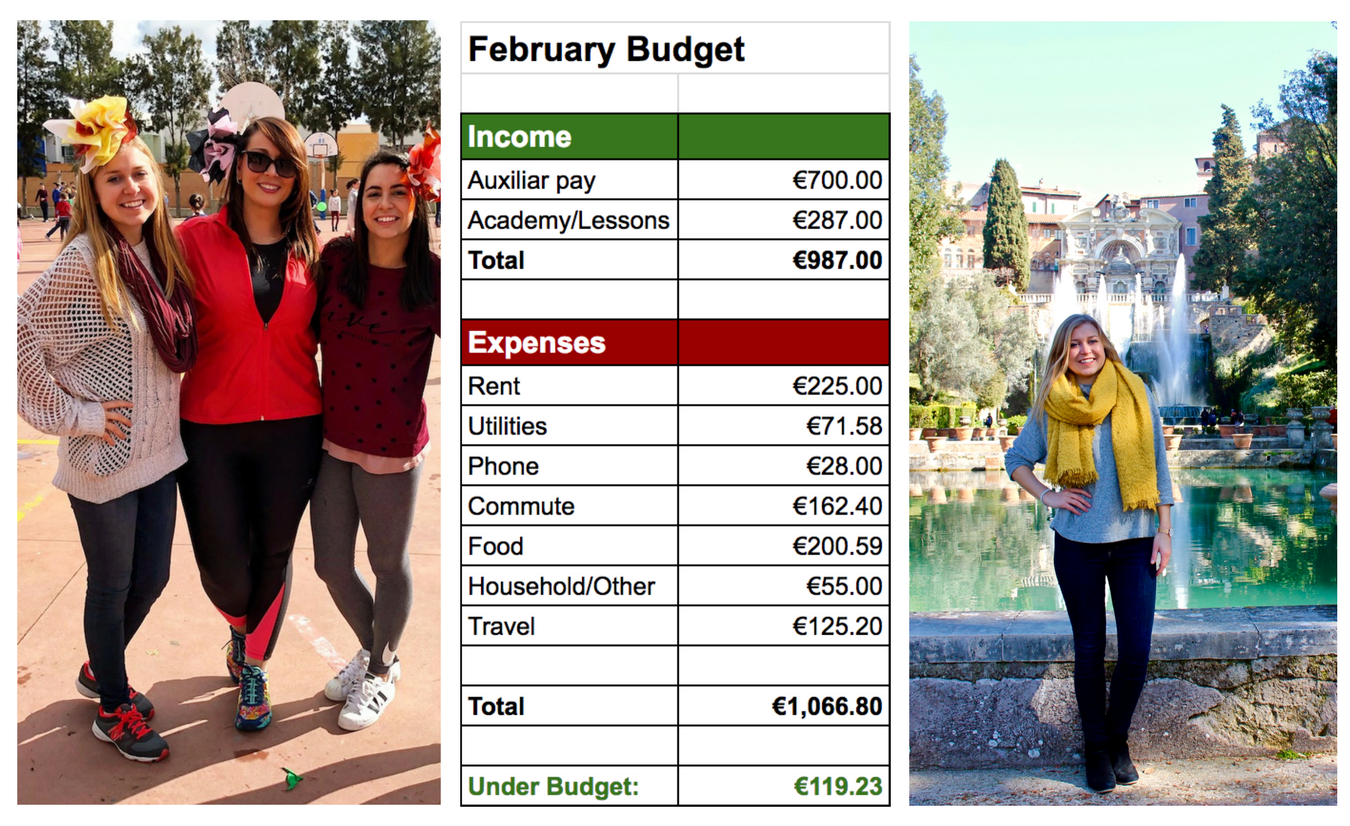
Ahhh February…finally a month where I was under budget! Under budget by €119.23 to be exact. So…how did I do it? For starters, February is a short month, and, believe it or not, two or three days really do make a difference! Also, I only traveled to Ronda, which is an easy day trip from Sevilla, and to Rome for the weekend. Full disclosure, I was able to visit Rome at minimal expense thanks to the RomeHello Hostel (read all about my visit here!). For more info on my life as an auxiliar this February, click here-I’m talking all about my favorite part of my job!
March
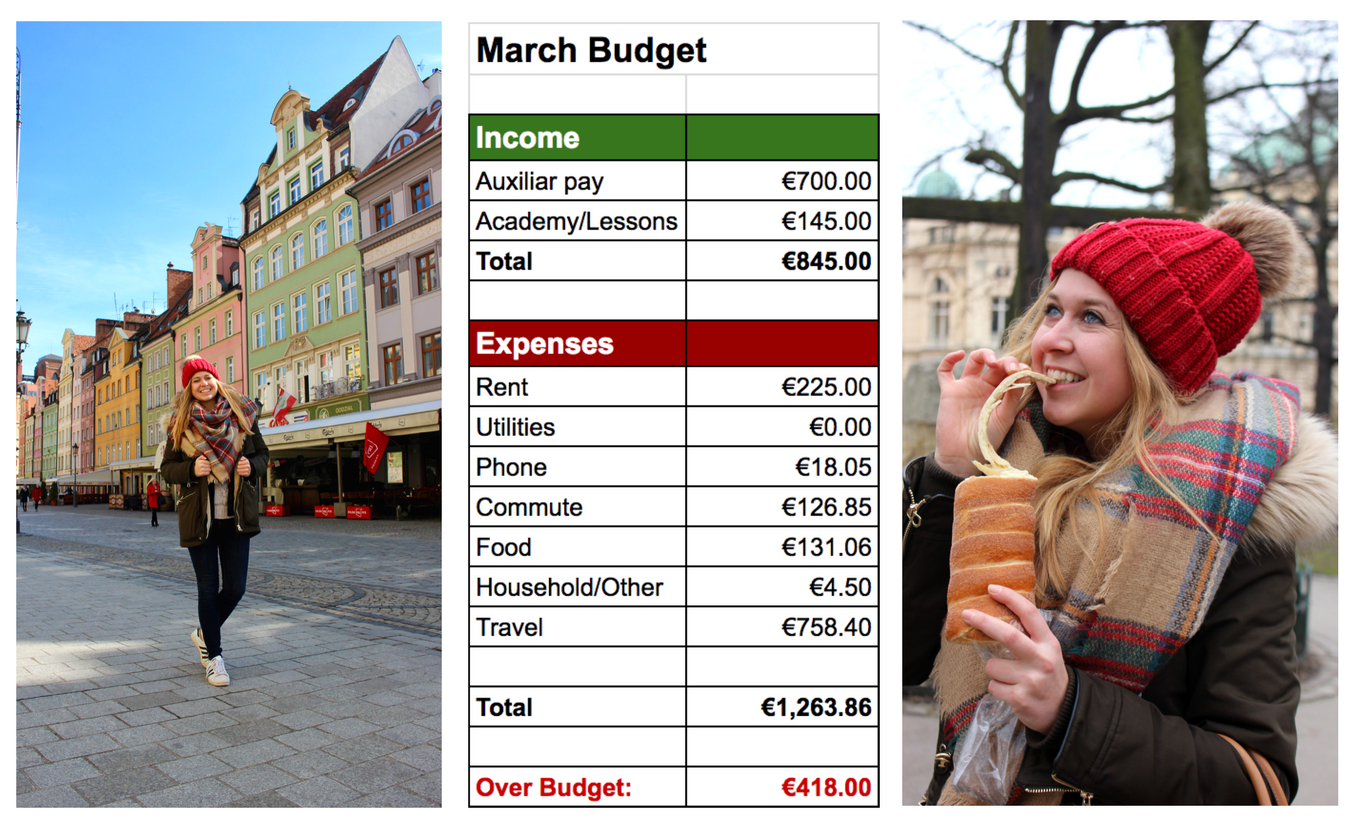
Spring Break forever! In March, we had a whole week to take off from school and go adventuring, so that’s exactly what I did! Unfortunately, this meant that I was quite over budget for the month of March (€418.00 over-ouch!). Having a week off work also meant some time off from teaching at the academy and my private lessons, so I only made an additional €145.00 this month, which did not help the situation. That being said, I had an amazing week in Poland and was prepared to spend more in March since I’d be traveling for an entire week. It did help that Poland is pretty inexpensive, so if you are looking to go somewhere for a week without breaking the bank, I’d highly recommend it!
April
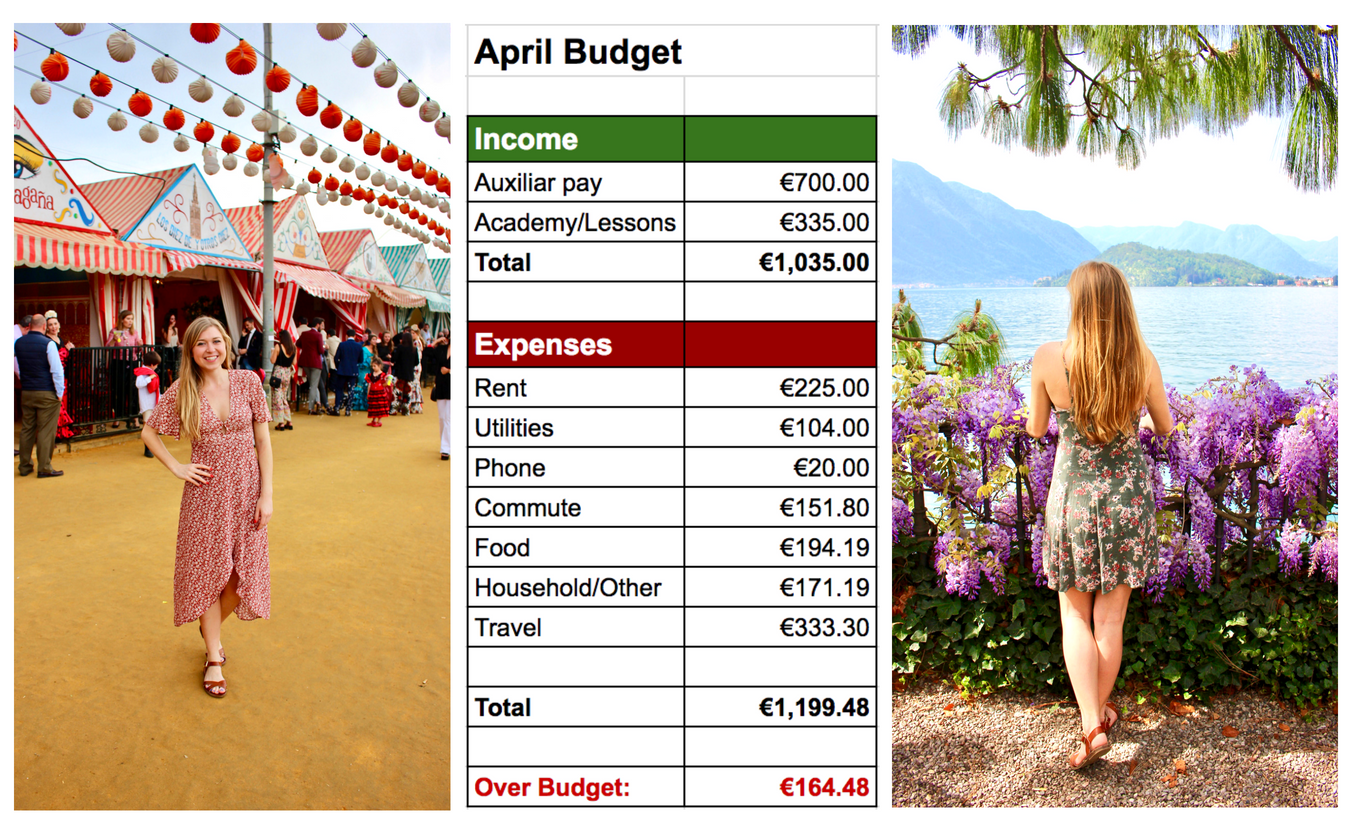
I had high hopes of staying within my budget during the month of April, but, alas, it was not to be! Unfortunately, my utility bills overlapped, which meant that I had to pay a bit more than I had anticipated! It is only fair though, considering that I didn’t have to pay any utilities in March. Additionally, I spend a long weekend in Italy, where I managed to visit Lake Como, Bologna, and Florence. I also did a bit of shopping, which meant more expenses for this month.
May
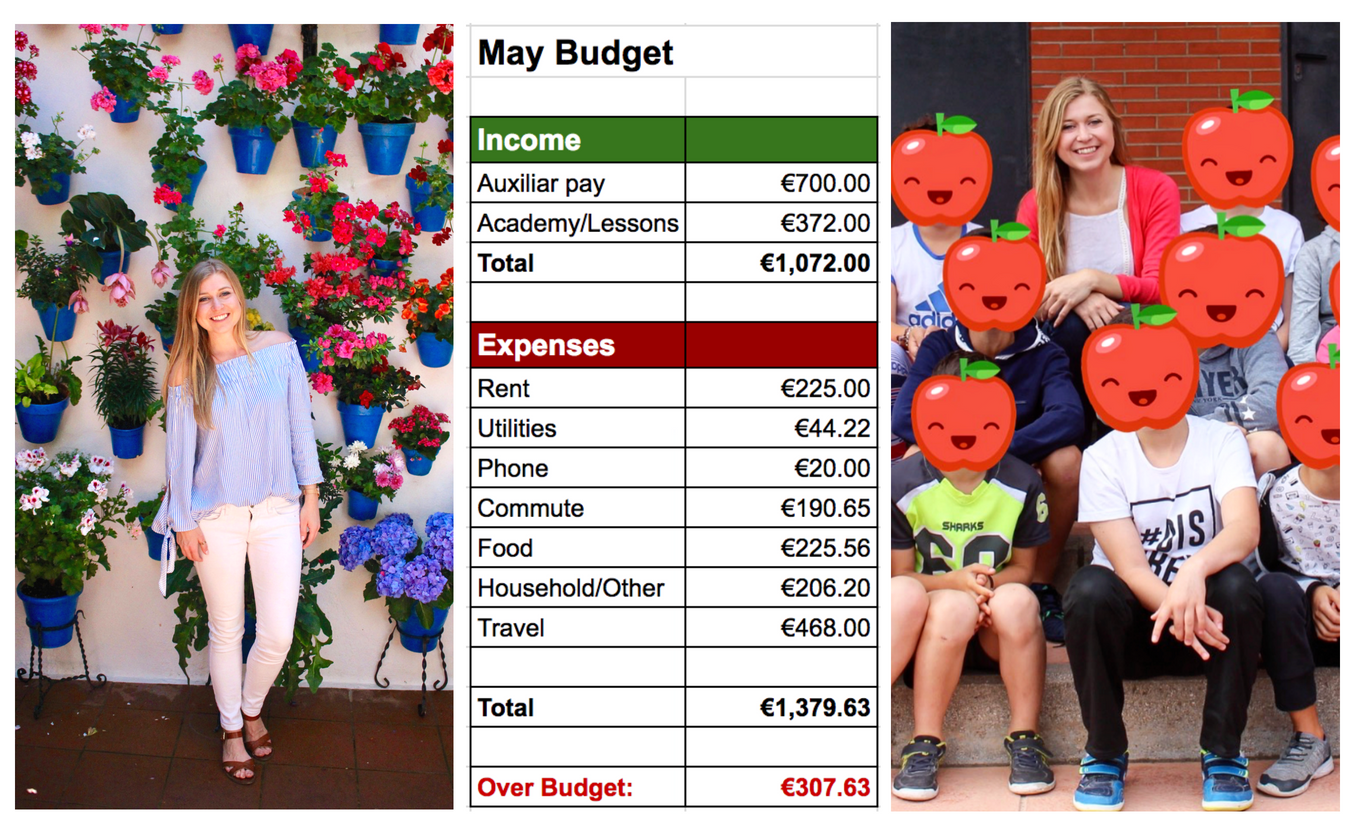
Ouch! My last month teaching was quite an expensive one! I took a day trip to the Festival of the Patios in Cordoba, and I also traveled to Florence and Milan (again, I know!). I also spent some money on clothes-I needed to purchase a dress and heels for a formal event I attended in El Puerto de Santa Maria, and also needed to purchase some clothes for summer. I definitely wish I could’ve spent less this month, especially since I have trips to Malta and Sicily planned for the month of June!
Whew! Thre you have it! Months of meticulously recording my expenses in the hopes that I could help answer some of your auxiliares de conversación budgeting questions. Do you have any tips for budgeting as an auxiliar or any questions? Let me know in the comments below!
Interested in learning more about life as an Auxiliar de Conversación? Then be sure to check out these posts:
- 10 Essential Tips For Your First Day Teaching English In Spain
- My First Month Teaching English In Spain As An Auxiliar de Conversación
- Teaching English In Spain: Auxiliar Updates
Pin this post for later!




How did you sign up or figure out how to teach your extra academy lessons? Did you work it out with your school or is it something you did on your own?
Hello Emily! The owner of the academy is a mother at the school I work at. She oftentimes works with auxiliares! However, I know of many people who have applied at language academies independently and found work that way! I hope that helps answer your question.