10 Essential Tips For Your First Day Teaching English In Spain
The first day of any new job can be a bit daunting, especially a new job in a foreign country! This fall, I moved to Spain to begin working as an auxiliar de conversación. Prior to moving to Spain, I had never taught before, and I must admit that my Spanish isn’t the greatest. Because of this, I was a bit nervous when October 2 (my first day of teaching) rolled around. However, I am happy to report that I not only got through but actually-dare I say-enjoyed my first day of school!
While you can read more about my first day of work as an auxiliar de conversación here, today I am sharing my top 10 tips to help your first day teaching English in Spain go as smoothly as possible!
Buena suerte!

1. Reach out to your school beforehand
When you receive your carta and placement from the Spanish Ministry of Education, there will be an e-mail address which you can use to contact your school. If you get your placement in June or July, you may not get a response right away as school is no longer in session. I sent my e-mail in late July and got a response from my Bilingual Coordinator a couple of weeks later. I was nervous about sending an e-mail in English, but when I asked other auxiliares via the 2017 auxiliares Facebook group, most people said that an e-mail in English is fine. Since my Spanish isn’t great, I figured it would be best to stick with English to avoid misrepresenting myself! However, if you are better at Spanish than I am, feel free to send an e-mail in Spanish!
While some schools are excellent about helping you out before you arrive, I know of other auxiliares who never got a response to their e-mail. My Bilingual Coordinator gave me her phone number, so I was able to ask her questions via Whatsapp before my first day. She also gave me the previous auxiliar’s phone number, so I was able to ask her questions about the school as well! This definitely helped lower my first day anxiety, especially because my coordinator was so friendly over the phone.

2. Practice your commute
Even if you are one of the auxiliares who is fortunate enough to be living close to their school, it is still a good idea to practice your commute before school starts to avoid getting lost or any mishaps. If you are like me and have a longer commute, then practicing is essential. After all, you don’t want to be late on your first day! I have to walk as well as take a bike, train, and bus to get all the way to my school which is 47 minutes outside of Sevilla, where I live. I am so glad I did a trial run of my commute beforehand, as that was the main source of my first-day jitters. I was even able to arrange to visit my school and meet my bilingual coordinator the day I first practiced my commute, so on my first day of school, I felt as though I had a good idea of what to expect!

3. Be prepared
Many auxiliares prepare a powerpoint presentation about themselves to share with their students on the first day. My bilingual coordinator didn’t ask me to prepare one, and in most of my classes the kids simply had time to ask me questions about myself. Even though I didn’t need to prepare a presentation, it is definitely a good idea to brainstorm what your answers to these questions may be! While many of the questions I got were simply “Where are you from?” “What is your favorite…?”, there were a few that caught me off guard! Don’t be surprised if you get asked “How old are you?” or “Do you have a boyfriend?” or even “Do you like Donald Trump?” (Yes, a first grader asked me that!).
You will also want to come prepared with food for lunch, a water bottle (I learned this the hard way and was parched all day), and possibly even something to do as you may have a free period or time during recess.
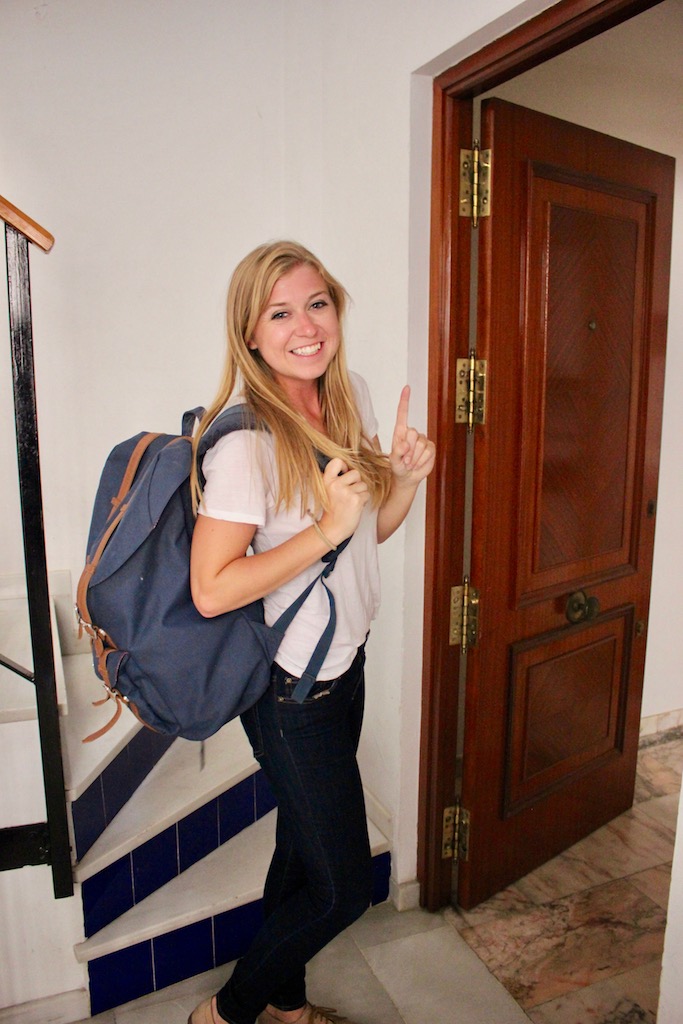
My first day of school! You can read all about it here!
4. Know what to wear
Fortunately, Spain is pretty relaxed when it comes to dressing for school. Many of the teachers wear jeans, and even leggings and tee shirts. I wore a nice blouse and jeans with a pair of cute but comfortable shoes on my first day and felt perfectly fine in that outfit. It is still quite hot in Andalucia in October, so I wore longer skirts/dresses and even more conservative tank tops in the following weeks. I recommend dressing up more your first day, and scoping out what the other teachers are wearing so you know what your school’s dressing culture is like.

5. Brush up on your Spanish
I have to be honest-my Spanish isn’t the best. And by isn’t the best, I mean that I understand a lot, but every time I open my mouth to speak, Italian comes out! (That’s what I get for taking Italian in college, studying abroad in Italy, and working in Italy as a tour guide for a year!) While I highly recommend learning as much Spanish as possible before moving to Spain, if you don’t have time, going over simple phrases like “Hola, cómo estás?” and “Gracias!” will go a long way. It is very likely that not every teacher at your school will speak English (I think about 50% of mine do!), so being able to exchange pleasantries in Spanish will be quite useful.
6. Speak slowly, clearly, and use hand signals
Since I teach 1st-6th grade, many of my younger students don’t have a very high level of English. To make communicating easier, I take extra care to speak slowly and clearly. It also helps to be animated-so don’t shy away from talking with your hands or acting something out!
I also had to adjust for my American/Midwest accent. When I first introduced myself, I said “Hello! My name is Catalina.” While my name is, funnily enough, a Spanish name (Fate? Destiny?), the students had a hard time understanding this right away because I pronounce the T softly, as in “KA-DUH-LEE-NUH”. To their ears, this sounds like a completely different name! Now I introduce myself as “KAHT-UH-LEE-NUH” and they understand perfectly.
7. Don’t worry, be confident!
I actually majored in Drama (and Art History) in college, which has prepared me for teaching incredibly well. I am very used to “performing” for an audience and making things up on the fly. That being said, for more introverted personality types, this can be quite a challenge! Just remember to stay confident and smile! Even if the students can’t understand much of or everything you say, smiling a lot will help you appear friendly and approachable. After my first day, my cheeks hurt from smiling so much!
8. Anticipate awkward moments
I won’t lie to you-there will definitely be awkward moments in the coming days, weeks, and months ahead as an auxiliar. Whether you are attempting to decipher cultural norms, befriend your coworkers, or are simply learning how to use the photocopier or find the right classrooms, you are bound to run into your fair share of mildly uncomfortable situations. If you mentally prepare yourself for this in advance, then it won’t seem so awkward when these situations arise. And always remember that if something truly uncomfortable happens, you can always discuss the issue with your Bilingual Coordinator. I definitely find myself in these situations frequently, especially as I don’t speak much Spanish, but it is all part of the experience (and makes for some funny stories!).
9. Ask questions
If you have any questions about the program or what the teachers expect of you, your first day is the perfect time to ask them! I had a list of questions ranging from days off/holidays to questions about what kinds of materials I would be expected to prepare for classes. In my experience, the teachers went out of their way to help answer anything that popped in my head. They are also great resources if you are having trouble finding an apartment, setting up your bank account, or applying for your TIE.

10. Don’t forget to have fun!
While it is your first day of work in a foreign country and that can be a little anxiety-inducing, don’t forget to have fun! You are finally here, teaching English in Spain after months of applying, waiting, preparing, and planning! You may even want to treat yourself to a relaxing weekend trip before or after your first week. I spent the weekend before school on some of Portugal‘s beautiful beaches, which totally helped take my mind off the week ahead and got me to stop stressing! 10/10 would recommend.
Do you have any concerns about or tips for a smooth first day as an auxiliar de conversación in Spain? Let me know in the comments! And don’t forget to read all about My First Day Teaching English In Spain As An Auxiliar de Conversación!
You might also like these auxiliar de conversación posts:
- Auxiliar de Conversación Budget: Exactly How Much I Make (And Spend) Each Month In Spain
- Teaching English In Spain: Auxiliares de Conversación November Update
- My First Day Teaching English In Spain As An Auxiliar de Conversación
- Dear Italy, I Love You, But I’m Leaving You For Spain
- Why Choosing To Live & Work Abroad After Graduating Was The Best Decision I Ever Made
Pin it for later!